
QuoteGraph tutorial
QuoteGraph is a guided car-insurance quote, not a toy conversation. It collects a driver, a
catalogued vehicle, an insurance history, and coverage choices. It calculates three quote tiers in
code, answers “what if” questions without a second model call, and completes only when the
customer accepts a tier from the current quote.
It is the track to read for the core EZGraph contract: LlmNodes whose tool handlers
validate input, write durable state, and return go(), stay(), direct(), or finish(). There
are no decision nodes here; for those, read the
DecisionHotelGraph track.
The implementation lives in
ezgraph-demo/src/graphs/quote-graph/,
and its tests live in ezgraph-demo/test/quote-graph/. The same application is also written in
plain LangGraph in src/graphs/quote-langgraph/; the
QuoteGraph case study compares the two.
The node graph
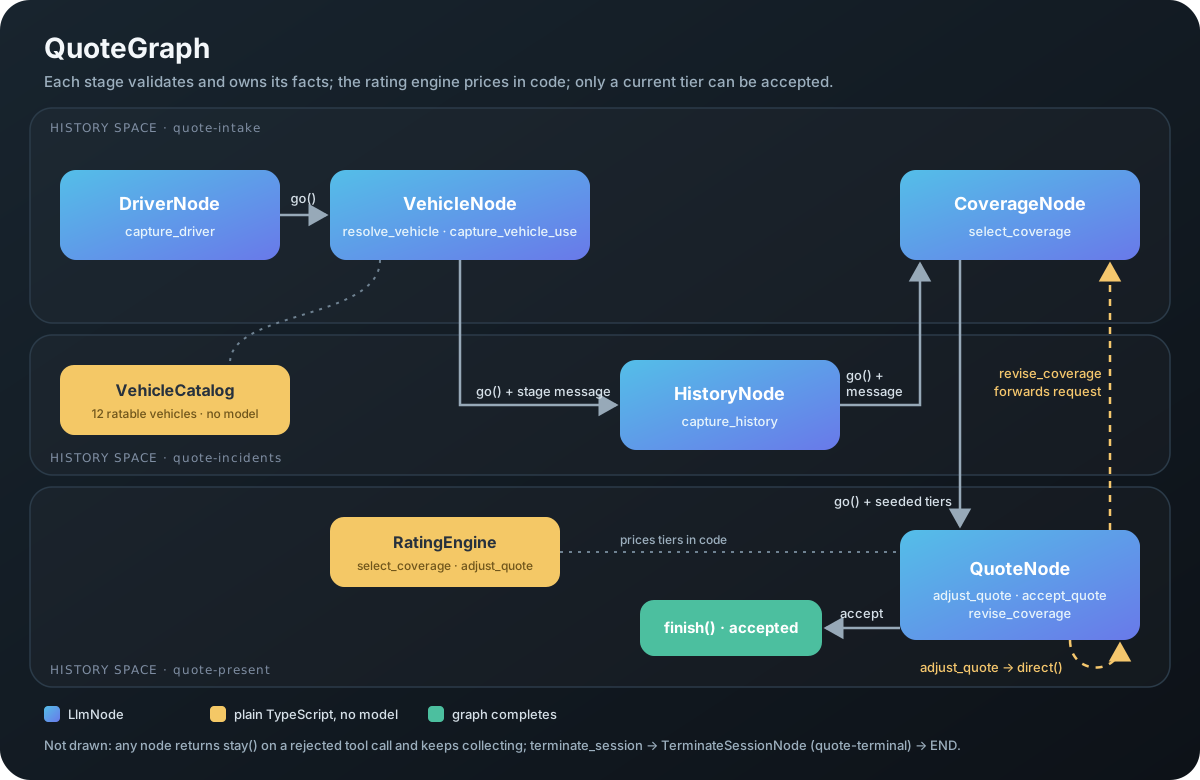
The shape is a pipeline with one loop at the end:
- Four collection stages move forward. Each saves its validated facts and returns
go()to the next stage, which runs in the same turn. A rejected tool call returnsstay()and the model asks again. - Coverage is the pricing boundary.
CoverageNodevalidates the selection against vehicle ownership, calls the rating engine, seedsQuoteNodewith the tiers, and enters it. - The quote loops until it is accepted.
adjust_quotere-rates and replies with code-written text throughdirect().revise_coveragegoes back toCoverageNodewith the customer’s words.accept_quotechecks the tier against the current list and completes withfinish().
The six registered nodes
| Node | History space | Owns | What it demonstrates |
|---|---|---|---|
DriverNode |
quote-intake |
driver |
Schema plus calendar, age, state-code, and licence rules; the entry node |
VehicleNode |
quote-intake |
resolvedVehicleId, vehicle |
Two tools, lookup before capture, trim disambiguation, a prompt that reacts to entry |
HistoryNode |
quote-incidents |
history |
An isolated history space; month-precision date rules |
CoverageNode |
quote-intake |
coverage |
A lender rule, deterministic rating, and seeding another node’s state |
QuoteNode |
quote-present |
tiers, acceptedTier, referenceNumber |
direct() answers, a backward route with a forwarded request, finish() |
TerminateSessionNode |
quote-terminal |
nothing | Ending the conversation at the customer’s request |
Supporting files
The graph, state, and node files import from @picoflow/ezgraph. The backend
modules are plain TypeScript that a unit test can call directly. Each node loads
its Markdown prompts with Prompt.file() at module scope and renders live
values with Prompt.replace() in getPrompt().
| File | Responsibility |
|---|---|
quote-graph.ts |
Graph definition, idle-session policy, and topology |
quote-graph.state.ts |
Domain types, the node-state registry, and the generated LangGraph annotation |
backend/quote-clock.ts |
“Today” (pinnable with QUOTE_GRAPH_CURRENT_DATE) and strict date arithmetic |
backend/vehicle-catalog.ts |
Loads data/vehicles.json and searches it by year, make, model, and trim |
backend/rating-engine.ts |
Coverage validation, the rating subject, the risk factor, premiums, and tiers |
data/vehicles.json |
Twelve ratable vehicles with trim, body style, risk group, and MSRP |
nodes/*.node.ts |
Load role and stage prompts directly, render {{PLACEHOLDER}} values, and append the local end-chat instruction |
prompt/role.md |
Persona, tone, and the termination rule shared by every stage |
prompt/driver.md, vehicle.md, history.md, coverage.md, quote.md |
One stage specification per node |
What this track does and does not cover
| Feature | In QuoteGraph? |
|---|---|
LlmNode tools with Zod schemas and @Tool handlers |
yes, all five stages |
go(), stay(), direct(), finish() |
yes |
withMessage() stage instructions and a forwarded customer request |
yes |
Writing another node’s state with graph.saveNodeState() |
yes, CoverageNode and QuoteNode |
| Separate history spaces | yes, four spaces |
A per-node model configuration with getLlmConfig() |
yes, QuoteNode |
Session expiry with onRestoreSessionDoc() |
yes |
| A pinnable business clock | yes |
directTo() |
no; see the DecisionHotelGraph track |
| Decision nodes and Jev | no; see the DecisionHotelGraph track |
| File attachments and JSON response mode | no |
| Schema versions and migrations | no; the graph uses the default schema version 1 |
The ten lessons
- A fifteen-turn live replay — the recorded quote, then the tools and transitions behind every turn.
- Graph, state, and ownership — the graph definition, the typed state registry, and who writes each value.
- Anatomy of a conversation turn — what the engine, the node, and the agent loop do between a customer message and a reply.
- Prompts and stage handoffs —
direct
Prompt.file()loading,Prompt.replace()templating, and three ways to start the next stage well. - Validated collection — schemas as the interface and code as the policy, in the driver and history stages.
- Catalog lookup and disambiguation — resolve a vehicle before capturing how it is used.
- Time, sessions, and history spaces — a pinnable clock, idle expiry, and four separate conversations.
- Deterministic rating — coverage rules, the risk factor, and a worked premium from the replay.
- Revisions, direct responses, and acceptance — the quote loop: adjust, revise, and accept.
- Testing the whole quote — unit, graph, and session-policy tests, then the live semantic evaluation.
Running it
cd ezgraph-demo
npm run test:quote-graph
npm run test2:quote-graph
The first script runs the deterministic suite with a scripted chat model; the provider-backed E2E
file it also matches is skipped. The second sets USE_ENV=1 KEEP_SESSION=1, runs the fifteen-turn
semantic scenario against the configured model provider, and keeps the session for inspection.
Both tiers pin QUOTE_GRAPH_CURRENT_DATE to 2027-06-01, so ages, incident windows, start dates,
and premiums are identical on every run.
Next
Start with 1. A fifteen-turn live replay.