
DecisionHotelFlow tutorial
Track overview
DecisionHotelFlow combines ordinary conversational Steps, typed Jev DecisionSteps, deterministic validation and search, grounded presentation, and safe provider fallbacks in one durable hotel-booking journey.
DecisionHotelFlow is the decision-model track. It uses a chat model where the
application needs conversation, TypeSafe’s Jev API where it needs a typed
classification or judgment, and ordinary TypeScript where it needs validation,
search, pricing, or a final side effect.
The implementation lives in
pico-demo/src/myflow/decision-hotel-flow/. Its deterministic contract and live
semantic replay live in pico-demo/test/decision-hotel-flow/. Browse the
DecisionHotelFlow source on GitHub.
What DecisionHotelFlow is
The flow collects five hotel criteria, lets the customer revise them in any order, reviews the normalized record before search, prices a local catalogue, reviews the generated result presentation, and books only a hotel from the saved result set.
Three DecisionSteps form typed boundaries:
RouterStepselects one declared destination and decides whether the latest request must be forwarded to a collector.CriteriaReadinessJudgeStepchecks whether the normalized record reflects the conversation before a read-only search.PresentationJudgeStepchecks a generated draft against the actual hotel names and prices before the user sees it.
Five ordinary Steps collect criteria. SearchHotelsStep is a model-free
LogicStep. PresentStep generates a draft, validates hotel selection in code,
and finishes the booking with an exact response.
The step graph
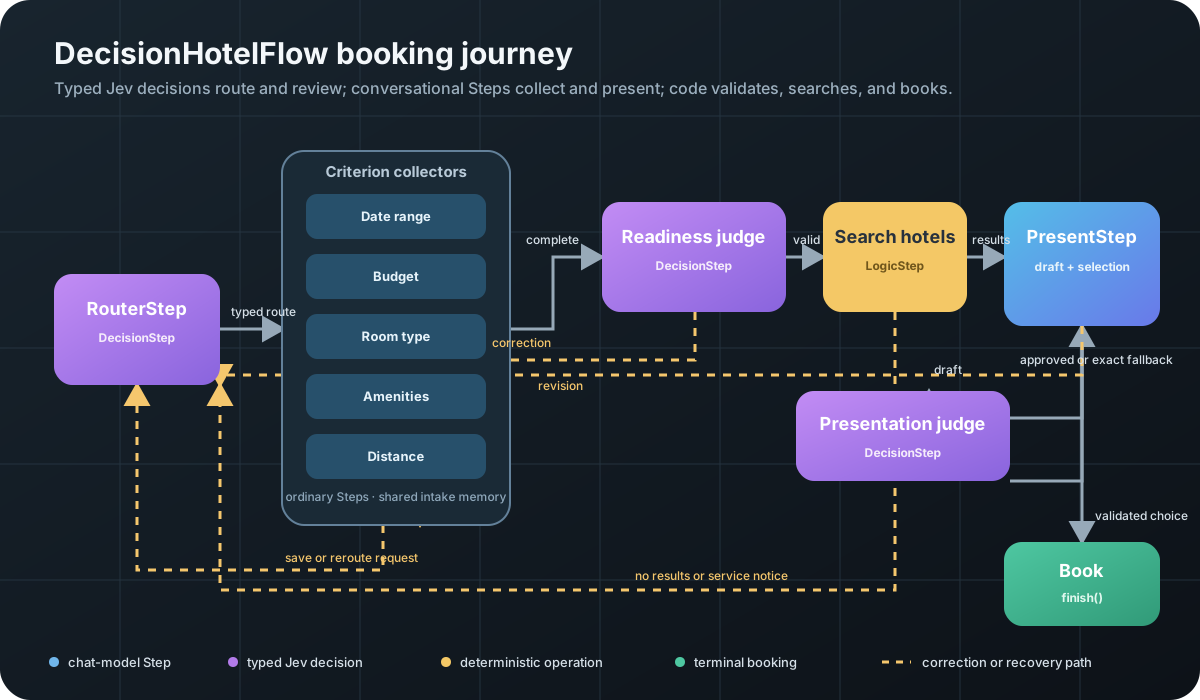
The durable cursor moves between registered steps, but several edges continue
within one HTTP turn. For example, a collector saves its value and returns
go(RouterStep); the router immediately selects the next collector, which asks
the next question before the turn ends.
The eleven registered steps
| Step | Kind | Memory | Owns | Boundary |
|---|---|---|---|---|
RouterStep |
DecisionStep |
intake |
notice, last route and answers | Typed intent routing and request delivery |
DateRangeStep |
Step |
intake |
valid check-in and checkout | Calendar and future-date validation |
BudgetStep |
Step |
intake |
minimum and maximum | Nonnegative, ordered range |
RoomTypeStep |
Step |
intake |
supported room type | Zod enum |
AmenityStep |
Step |
intake |
normalized amenities | Allowlisted values and explicit no preference |
DistanceStep |
Step |
intake |
airport and city-center limits | Nonnegative optional values |
CriteriaReadinessJudgeStep |
DecisionStep |
intake |
review and accepted flag | Semantic review after deterministic validation |
SearchHotelsStep |
LogicStep |
class default | no durable state | MCP-backed search and deterministic branching |
PresentStep |
Step |
present |
results, criteria, draft, selection, confirmation | Drafting and validated booking |
PresentationJudgeStep |
DecisionStep |
present |
review and accepted flag | Grounding, completeness, and clarity |
TerminateSessionStep |
framework | end |
none | Registered terminal path |
The whole flow class
export class DecisionHotelFlow extends Flow {
  protected override configModel() {
    return { provider: 'openai', name: 'gpt-4o', retryAttempts: 2 } as const;
  }

  protected override configLlmCallPolicy() {
    return { timeoutMs: 60_000 };
  }

  protected override configDecision() {
    return {
      provider: 'typesafe',
      model: 'jev-latest',
      timeoutMs: 15_000,
      maxRetries: 2,
    };
  }

  protected override defineSteps(): Step[] {
    return [
      new RouterStep(this).useMemory('intake'),
      new DateRangeStep(this).useMemory('intake'),
      new BudgetStep(this).useMemory('intake'),
      new RoomTypeStep(this).useMemory('intake'),
      new AmenityStep(this).useMemory('intake'),
      new DistanceStep(this).useMemory('intake'),
      new CriteriaReadinessJudgeStep(this).useMemory('intake'),
      new SearchHotelsStep(this),
      new PresentStep(this).useMemory('present'),
      new PresentationJudgeStep(this).useMemory('present'),
      new TerminateSessionStep(this).useMemory('end'),
    ];
  }
}
Chat and decision policy are deliberately separate. retryAttempts: 2 is the
total chat-model attempt budget. maxRetries: 2 permits two additional decision
attempts after the first. Both deadlines apply per attempt.
What this track demonstrates
| Feature | In DecisionHotelFlow? |
|---|---|
DecisionStep with Choice, Score, and Noul questions |
yes |
Dynamic defineQuestions() from current state |
yes, RouterStep |
getDecisionFacts() plus framework-owned conversation input |
yes |
Step-local onDecisionError() fallback |
yes, all three decision steps |
| Shared and isolated memory namespaces | yes, intake, present, and end |
| Deterministic validation before model judgment | yes |
Model-free LogicStep search |
yes |
| Grounded presentation with exact fallback rendering | yes |
Validated terminal side effect with finish() |
yes |
| Deterministic adapter contract and live provider evaluation | yes |
Parallel runSteps() or batch mode |
no |
The seven lessons
- A sixteen-turn live replay — invalid inputs, a cross-step correction, criteria review, empty results, revision, grounded presentation, and booking.
- Designing a decision-backed workflow — stage boundaries, model boundaries, state ownership, and registration.
- Anatomy of a DecisionStep — questions, shared guidance, facts, conversation input, typed answers, and provider registration.
- Typed routing and cross-step corrections — dynamic questions, independent batched decisions, and forwarding the original request.
- Readiness and deterministic search —
why a judge cannot override code validation, and why search is a
LogicStep. - Grounded presentation and booking — draft review, deterministic rendering, revision, and selection validation.
- Fallbacks and two-tier testing — step-local outage policy, decision usage, deterministic adapters, and live evidence boundaries.
Running it
DecisionHotelFlow is registered with the other flows on AppModule’s shared
engine. Its session database uses the same inline MongoDB/Cosmos factories;
Jev’s decisionProviders registration is separate from database authentication.
See the bootstrap lesson
and persistence guide.
The live suite retains the configured SESSION_STORE, defaulting to memory
when unset; the contract suite uses memory explicitly.
cd pico-demo
npm run test:decision-hotel-flow:contract
npm run test:decision-hotel-flow
The contract is deterministic and needs no provider credentials. The live test requires PicoFlow, OpenAI, and TypeSafe credentials; without them it is skipped.
Next
Start with 1. A sixteen-turn live replay.