
SupportFlow tutorial
Track overview
A durable post-purchase support case that verifies an order, routes the request to a specialist, applies policy without an LLM decision, and closes with a factual recap.
SupportFlow is the stateful-conversation track. It models a narrow but realistic
post-purchase support case: first verify the customer’s order, then route either a
return or billing concern to the appropriate specialist. Deterministic steps apply
return policy, compute the exact refund, or create a billing ticket; the model never
gets to invent eligibility, money, or an outcome.
The implementation lives in pico-demo/src/myflow/support-flow/, and its
turn-by-turn scenario lives in pico-demo/test/support-flow/. Browse the
SupportFlow source on GitHub.
What SupportFlow is
A Flow subclass with four important pieces of configuration:
configModel()sets the OpenAIgpt-4odefault for ordinary conversational steps and the Flow-owned limit of three runner attempts.defineSteps()registers five conversational steps, twoLogicSteps, andTerminateSessionStep.- The constructor enables summary memory for the triage namespace after eight messages, preserving four recent messages verbatim.
onRestoreSessionDoc()rejects sessions idle for 30 minutes and releases a pending approval back to triage after its 10-minute hold expires.
The first registered step, TriageStep, is the initial step. It is the case hub:
it verifies an order, sends return and billing work to specialists, and eventually
closes the case.
The graph
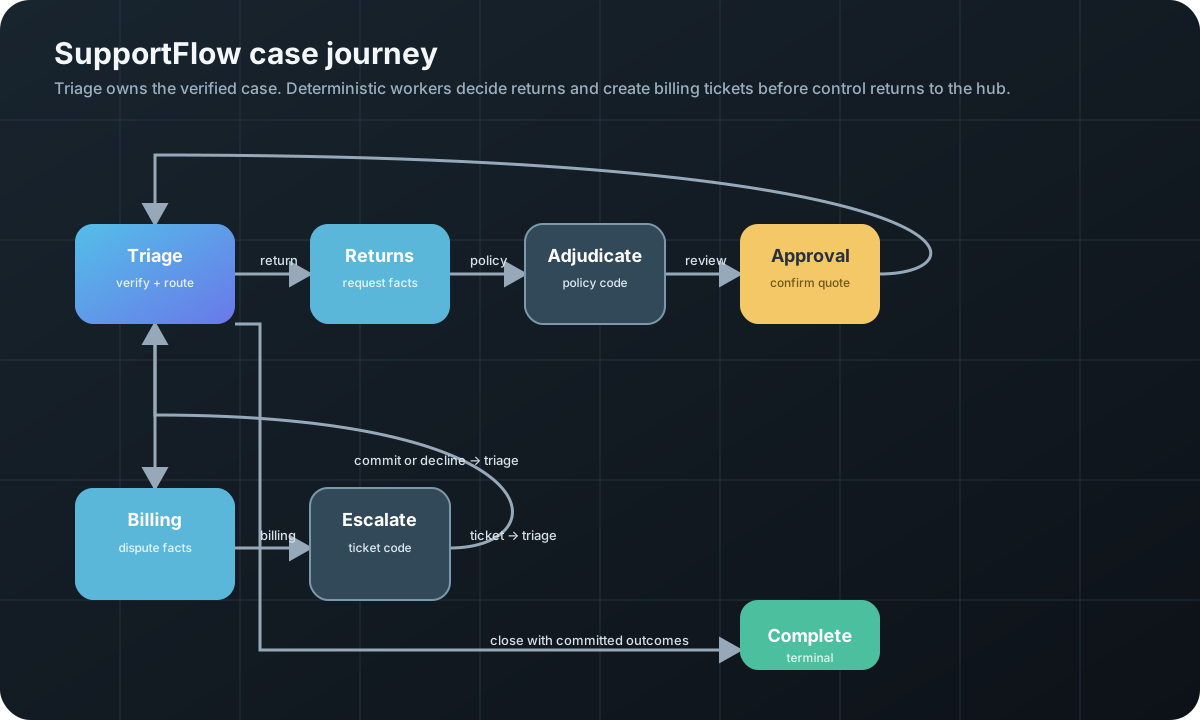
There are two purposeful hub-and-spoke loops. A return is collected by
ReturnsStep, adjudicated without an LLM turn, and then either denied, committed
automatically, or held in ApprovalStep for explicit customer confirmation.
Billing follows a separate spoke: BillingStep validates the charge IDs and
EscalateStep creates the ticket in code before returning to the hub.
The seven registered steps
| Step | Memory namespace / model | Responsibility |
|---|---|---|
TriageStep |
support-triage; gpt-4o, temperature 0.3 |
Verifies the order, routes the request, and closes a case only after an outcome is recorded. |
ReturnsStep |
support-returns; gpt-5.1, low reasoning effort |
Collects a return item and reason without quoting eligibility or a refund. |
AdjudicateStep |
default namespace; LogicStep |
Runs PolicyEngine against the order catalogue and chooses deny, auto-approve, or review. |
ApprovalStep |
support-approval; gpt-5.1, low reasoning effort |
Presents the computed quote and commits it only after an unambiguous confirmation. |
BillingStep |
support-billing; flow default model |
Validates disputed charge IDs and recomputes their amount from the ledger. |
EscalateStep |
support-billing; LogicStep |
Creates a durable ticket from the validated dispute before returning to triage. |
TerminateSessionStep |
support-terminal |
Ends the session after close_case creates a recap. |
TriageStep owns the verified order and the case outcomes. The specialist steps
read that state with flow.getStepState(...), while their own namespaces preserve
the context unique to a return, approval, or billing request. This separation lets
the flow carry a long-running case without giving every specialist every prior turn.
Where the decisions happen
The conversational steps use tools for bounded data collection. Their tool schemas accept only an order ID and verification secret, a known return reason, or known charge IDs. The handlers then recheck that input against the local order book.
PolicyEngine.adjudicate() is the policy boundary. It rejects undelivered, final
sale, already-returned, and expired-window items; it computes shipping refunds and
electronics restocking fees; and it requires confirmation whenever a refund exceeds
the $250 auto-approval limit. AdjudicateStep turns that result into a route rather
than asking a model to decide it.
The same pattern protects billing. BillingStep ignores the model-provided disputed
amount and recomputes it from the selected ledger entries. EscalateStep then creates
the ticket in a LogicStep, so an accepted dispute cannot be lost because the model
failed to emit a second tool call.
The prompts explicitly prohibit calculating, estimating, negotiating, or promising money, eligibility, or timing. The deterministic services calculate outcomes; the model gathers the facts and communicates the recorded result.
Session and approval lifecycle
The custom restore hook is part of the workflow, not just cleanup. A stale session
returns null, so the engine starts a new case after 30 minutes of inactivity. A
session paused in ApprovalStep is more restrictive: after 10 minutes, the hook
removes its pending quote and puts the cursor back at TriageStep. An old approval
therefore cannot be confirmed after the hold has expired.
The support track also demonstrates why durable state belongs in the flow instead of in prompt text. Refunds and tickets are stored under triage state, returned line IDs under the returns step, and the short-lived pending quote under approval state. The closing step can then produce a factual recap from those committed records.
Running it
SupportFlow uses AppModule’s shared engine and inline MongoDB/Cosmos client
factories. See the
bootstrap lesson
and persistence guide
for configuration and cleanup. Set USE_ENV=1 on the test command to retain
that configured store; the default test uses isolated SQLite.
From the demo application:
npm run test:support-flow
The scenario verifies an order, routes a return through an approval hold, records an auto-approved refund, opens a billing ticket, and closes the case with both identifiers in the recap. It also asserts the guardrails: no RMA before confirmation, no invented credit for a billing dispute, and no closing a case with no committed outcome.
The seven lessons
- A nine-turn live replay — the recorded case interaction and its approval prompt.
- Designing a support case — why triage, returns, approval, billing, and deterministic workers are separate steps.
- Verifying and routing requests —
bounded tools at the hub,
stay(), forwarding the customer’s request, and a truthful terminal recap. - Deterministic return policy —
collecting a request in a conversational step and deciding it in a
LogicStep. - Approval holds and session restoration — committing an exact quote only after consent and expiring an old hold safely.
- Billing disputes and escalation — recomputing ledger totals and creating a ticket without another model call.
- Memory and durable case state — namespace isolation, triage-owned outcomes, and summary compaction.
- Testing a support case — deterministic policy tests plus the nine-turn live scenario.
Next
Start with 1. A nine-turn live replay.