
HotelFlow tutorial
Track overview
HotelFlow is a four-step booking conversation that collects criteria, searches a local catalogue, compares results, and books a room. This page maps the whole graph before the lessons take it apart.
HotelFlow is the transactional track. Where BasicFlow is a tour of the Step
contract, HotelFlow is one product journey — search, look, compare, go back,
book — expressed as four registered steps that move a single durable cursor
between them while keeping business state on the step that owns it.
The implementation lives in pico-demo/src/myflow/hotel-flow/. Its fourteen-turn
deterministic scenario lives in pico-demo/test/hotel-flow/. Browse the
HotelFlow source on GitHub.
What HotelFlow is
A Flow subclass with a constructor and two overrides:
- The constructor configures rolling memory compaction for one namespace.
configModel()declares the flow default,openai/gpt-4o, with three runner attempts.defineSteps()returns fourStepinstances, each with its own memory namespace and model override.
There is no initialStep() override, so the first entry in defineSteps() —
ExploreStep — is the initial cursor.
The conversation itself is driven by two large prompt files that read like specifications rather than instructions, plus a mutable JSON scaffold that the model fills in over several turns and hands back through a single tool call.
The step graph
Every edge below is a go(...) or direct(...) returned from a @Tool handler.
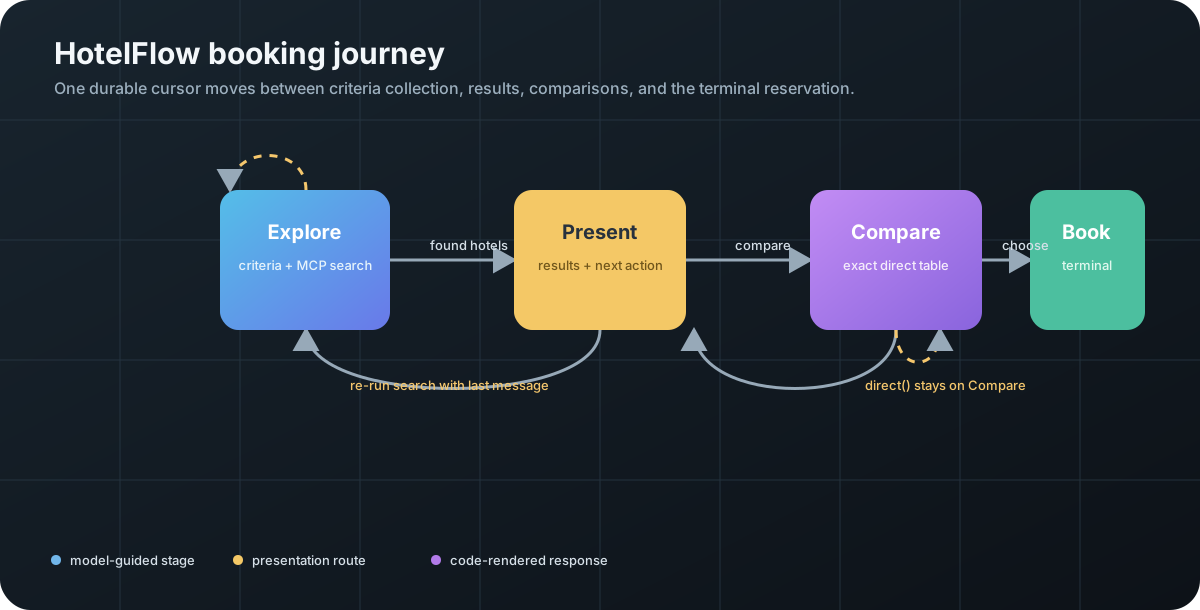
Two edges are deliberately drawn as self-loops:
capture_choicesreturnsstay(...)when the catalogue matches nothing. The turn is not lost; the corrective text goes back to the model, which asks the user to loosen a criterion.generate_comparisonreturnsdirect(table).direct()targets the currently executing step, so the cursor never moves and no second model call is made — the rendered Markdown table is the response.
Every step except TerminateSessionStep also defines its own
terminate_session tool, so an explicit “bye” jumps to the terminal step from
anywhere. Those three edges are collapsed into one arrow above.
The four registered steps
defineSteps() returns these instances in this order:
| Step | File | Memory namespace | Model override | What it demonstrates |
|---|---|---|---|---|
ExploreStep |
explore-step.ts |
hotel-explore (summarised) |
openai / gpt-5.1, reasoning.effort: "low" |
A task-list prompt file, a mutable JSON scaffold, typed capture criteria, an MCP-backed search, and go().withState() against stay() |
PresentStep |
present-step.ts |
class default, PresentStep |
openai / gpt-4o, temperature: 0.5 |
onEnter() memory erasure, onCrossing() seeding, a three-way branch, and withPrompt() handoff |
CompareStep |
compare-step.ts |
class default, CompareStep |
openai / gpt-5.1, reasoning.effort: "low" |
direct() responses, cross-step state reads, and a return transition |
TerminateSessionStep |
framework | end |
none, uses flow default gpt-4o |
The built-in terminal step and the _prompt handoff |
“Class default” means the step never called .useMemory(...), so Step’s constructor set memorySpace to the class name. PresentStep and CompareStep therefore have completely isolated histories, which is what makes erasing them on entry safe.
Supporting files
None of these import anything from @picoflow/core. That separation is the
point of lesson 3.
| File | Responsibility |
|---|---|
backend/hotel-catalog.ts |
Loads data/hotels.json once and filters by amenities, room type, and distance |
backend/pricing-engine.ts |
Enumerates stay dates, applies month, holiday, room, and weekend multipliers, filters by nightly budget, and totals |
tools/hotel-pricing-mcp-*.ts |
Typed local stdio MCP service and client adapter for hotel search |
gen-chart.ts |
Flattens hotel records and renders the Markdown comparison table |
data/hotels.json |
Thirty-two Portland-area hotel records with amenities, room types, a level base price, and distances |
prompt/hotel-prompt.ts |
Loads role.md as a reusable partial |
prompt/role.md |
Persona, tone, and the escalation rule for ending the chat |
prompt/explore.md |
The eight-task criteria-collection specification |
prompt/explore.json |
The JSON scaffold injected into the explore prompt |
prompt/present.md |
Result presentation and the three follow-up actions |
prompt/compare.md |
A four-state comparison machine with a feature-synonym map |
What this track does and does not cover
HotelFlow was written to make four things unavoidable: large externalised prompts, a typed MCP-backed business operation, memory compaction, and answering without a model call. It is silent on everything else.
| Feature | In HotelFlow? |
|---|---|
| Memory compaction and rolling summaries | yes, ExploreStep only |
direct() responses with no second model call |
yes, CompareStep |
| Per-step model overrides and named namespaces | yes, all four steps |
Cross-step state via saveStepState / getStepState |
yes |
Multi-tool batching with @Tools([...]) |
no |
Structured output via structOutputSchema() |
no |
Nested execution with runStep() / runSteps() |
no |
Concurrent batch mode with spawnSteps() |
no |
| Multimodal file uploads | no |
For batching, structured output, and nesting, read the BasicFlow track. For file uploads and batch fan-out, read the InvoiceFlow track.
The seven lessons
- A fourteen-turn live replay — the complete recorded search, comparison, and booking interaction.
- Designing a multi-stage workflow — mapping a user journey onto steps, and why registration order picks the entry point.
- Big prompts as spec files —
Prompt.file(), prompt composition, and the mutable JSON scaffold. - MCP-backed hotel search — typed criteria, an MCP service boundary, and PicoFlow-owned routing.
- Memory compaction and erasure —
enableSummary(), the compaction thresholds, anderaseMemory(). - Branch, forward, and return —
onCrossing(),.withMessage(...), and priming a step before you enter it. - Answering without an LLM —
direct()and building a Markdown table from cross-step state. - Present and book — the present-and-choose prompt and the terminal handoff.
Running it
HotelFlow uses the shared engine and application-owned MongoDB/Cosmos factories
in app.module.ts. Follow the
bootstrap lesson
and persistence guide
to configure its session store. Set USE_ENV=1 on the test command to retain
that configured store; the default test uses isolated SQLite.
npm run start:dev
npm run test:hotel-flow
The scenario pins HOTEL_FLOW_CURRENT_DATE to 2027-07-15T00:00:00.000Z and
books a stay from 1 August to 8 August 2027, so the prices and the comparison
tables are reproducible across runs.
Next
Start with 1. A fourteen-turn live replay.